
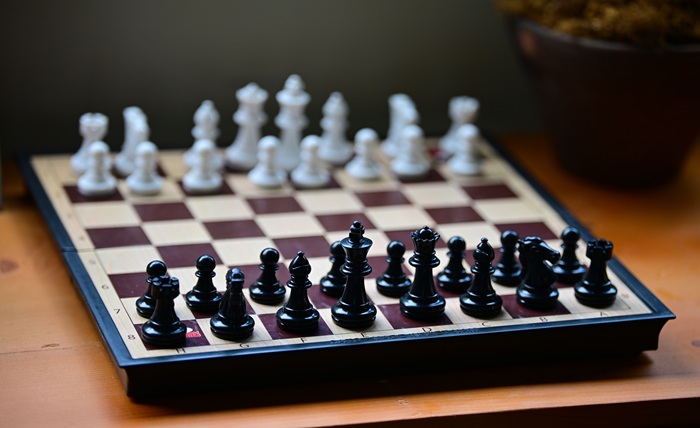
A tournament game shows only a fraction of the work required to compete at the top of chess. Spectators see Vidit Gujrathi sit at the board, make decisions, manage the clock, and respond to an opponent. They do not see the hours spent analyzing openings, reviewing previous games, solving positions, preparing for specific rivals, maintaining physical condition, and organizing recovery. At elite level, the result of one game can depend on preparation completed weeks or months before the first move.
The contrast between visible performance and hidden preparation is important because digital audiences are accustomed to immediate outcomes. Someone can move from tournament coverage to unrelated entertainment such as adventures beyond wonderland apk without seeing the work behind either experience, while Gujrathi’s competitive routine is built around a long preparation cycle. For a top chess player, performance is not simply what happens during several hours at the board. It is the final stage of a larger system.
Opening Preparation Is an Information Problem
Elite players cannot study every possible opening variation with equal depth. There are too many positions and too little preparation time.
The first task is therefore selection.
Gujrathi and his team need to identify which openings are likely to appear, where an opponent has repeated certain lines, and which positions offer useful practical opportunities. This requires studying databases, recent games, move orders, and tendencies.
The objective is not always to discover a forced advantage.
Sometimes preparation succeeds by reaching a position that Gujrathi understands better than his opponent. A small difference in familiarity can save valuable time and reduce the number of difficult decisions required during the game.
Opponent Analysis Goes Beyond Openings
Preparing for a player involves more than checking which first moves appear most often.
A team can examine how an opponent handles different pawn structures, whether certain exchanges are preferred, how frequently the player enters endgames, and which types of positions have caused problems in previous tournaments.
Time management can also provide information.
If an opponent regularly spends significant time at particular stages of a game, preparation may aim to create similar decisions.
Gujrathi can then enter the game with hypotheses rather than guarantees. The opponent may change strategy, but preparation provides a starting framework.
Seconds Help Expand the Player’s Capacity
Top chess preparation is often collaborative.
A second can analyze opening variations, search for improvements, test ideas, and challenge assumptions. This allows the player to process more information than would be possible alone.
The value of a second is not limited to finding moves.
A good training partner can disagree.
If every idea is accepted without resistance, preparation may create false confidence. Critical analysis helps identify positions where an attractive plan fails against accurate defense.
For Gujrathi, collaboration can therefore function as quality control before an idea is tested in competition.
Calculation Must Be Trained Separately
Opening knowledge cannot replace calculation.
Preparation eventually ends, sometimes after ten moves and sometimes much later. At that point, the player must solve the position independently.
Calculation training usually involves positions where the correct continuation is not obvious. The goal is to identify candidate moves, examine responses, compare resulting positions, and reach a conclusion without moving the pieces.
This trains disciplined thinking.
For Gujrathi, calculation work supports both tactical and strategic decisions. Even a quiet position can require accurate calculation when one pawn break changes the structure or one exchange leads to an endgame.
Physical Preparation Supports Mental Work
Chess does not require running or physical contact during competition, but long games place demands on concentration.
A player may spend several hours calculating while controlling emotional reactions and monitoring the clock. Tournaments repeat this process across many rounds.
Physical condition can support the ability to maintain attention.
Exercise, sleep, nutrition, and recovery therefore become part of preparation. Their purpose is not to make a player physically stronger than an opponent. It is to reduce avoidable declines in concentration.
For Gujrathi, this becomes especially important during events where one demanding game is followed by another with limited recovery time.
Tournament Preparation Requires Information Control
Elite players face another problem: prepared ideas can lose value once they become public.
If Gujrathi introduces a new opening concept in one tournament, future opponents can analyze it immediately.
Preparation must therefore be managed as a resource.
Some ideas may be suitable for regular events, while others can be reserved for competitions where surprise has more value. A player may also use several move orders to reach similar structures, making preparation harder to predict.
This creates a strategic layer outside individual games.
The team is not only asking whether an idea works. It must also decide when the idea should be revealed.
Recovery Is Part of the Competitive Process
A tournament does not stop after a difficult loss.
The player may have less than a day before the next round. Detailed analysis is useful, but excessive analysis can consume time needed for recovery and preparation.
Gujrathi therefore needs to separate immediate lessons from work that can wait until after the event.
The same applies after a win.
A strong result can create excitement, but the next opponent presents a different problem. Emotional stability helps prevent one game from influencing the preparation for another.
Recovery is therefore both physical and cognitive.
Preparation Must Still Allow Flexibility
Too much dependence on preparation can become a weakness.
An opponent may choose an unexpected opening on move one or deliberately enter a line that has rarely appeared in previous games.
At that moment, Gujrathi needs to abandon the script without losing confidence.
The purpose of preparation is not to eliminate independent thinking. It is to provide a foundation from which independent thinking can begin.
The best-prepared player is not necessarily the one who remembers the most variations. It may be the one who understands why those variations work.
The Hidden Structure Behind Elite Performance
Vidit Gujrathi’s games illustrate how little of elite chess preparation is visible during the actual contest. The moves on the board are supported by opening research, opponent analysis, calculation training, collaboration, physical routines, recovery, and decisions about when to use prepared ideas.
None of these elements guarantees victory.
Together, however, they reduce uncertainty and allow the player to spend more mental energy on the problems that cannot be predicted.
That is the invisible work behind a top chess player. The tournament game may last a few hours, but the preparation behind those hours can stretch across an entire season.