
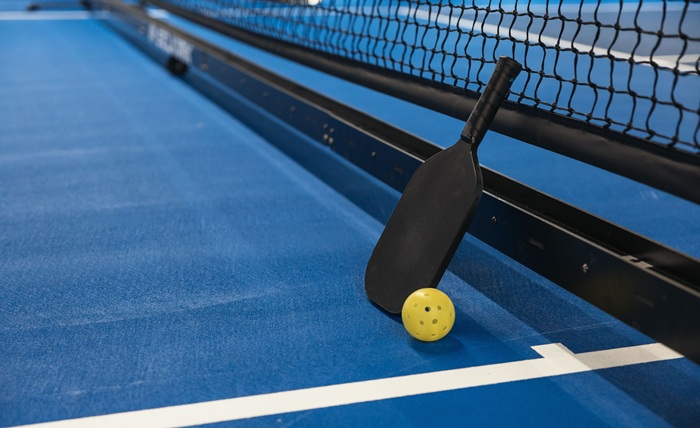
Few sports have grown as rapidly as this paddle game, transforming from a makeshift family activity invented one summer afternoon into America’s fastest-growing sport within just a few short decades. Understanding both the game’s fundamental rules and its genuinely entertaining, contested origin story provides a complete picture of why pickleball has captured such widespread enthusiasm. Fans wanting to follow sports coverage can check the latest updates at Dbbet, where sports coverage stays current across a wide range of competitive disciplines.
Understanding What Is Pickleball at Its Core
What is pickleball comes down to a genuinely accessible paddle sport combining elements from tennis, badminton, and table tennis, played on a compact court with solid paddles and a perforated plastic ball similar to a wiffle ball.
The sport can be played either as singles or doubles, though doubles remains considerably more popular across recreational and competitive play alike, reflecting the game’s social, community-oriented appeal that distinguishes it from more individually-focused racquet sports.
This blended equipment and rules foundation reflects pickleball’s genuinely improvised origins too, since the sport’s inventors literally combined whatever sporting equipment happened to be available in their garage rather than designing something entirely from scratch.
The Origin Story: How Pickleball Was Actually Invented
Pickleball’s creation traces back to a specific summer day in 1965 on Bainbridge Island, Washington, when Congressman Joel Pritchard and businessman Bill Bell returned home from golf to find their families with nothing to do.
Discovering an old badminton court in the Pritchard backyard but lacking a complete set of proper equipment, the two men improvised using ping-pong paddles and a perforated plastic ball, lowering the badminton net to create something genuinely new.
Their friend Barney McCallum joined the following weekend, and together the three men developed the foundational rules specifically designed to create a fun, accessible game the entire family could enjoy regardless of age or athletic ability.
Why Is It Called Pickleball: The Two Competing Stories
Addressing why is it called pickleball requires acknowledging genuine historical dispute, since two distinctly different origin stories have circulated for decades, each with passionate defenders among the sport’s founding families and their descendants.
The most widely repeated story claims the game was named after the Pritchard family dog, Pickles, who supposedly chased the ball during early matches, a charming tale that stuck firmly in popular culture despite growing evidence contradicting it.
Records uncovered through subsequent investigation, including detailed research by Pickleball Magazine’s Wayne Dollard, showed that Pickles the dog wasn’t actually born until 1968, three years after pickleball’s actual invention, meaning the dog was named after the game rather than the reverse.
The Pickle Boat Theory: A More Credible Origin
The alternative and increasingly credited explanation traces back to Joan Pritchard, Joel’s wife, who had followed competitive rowing regattas since her college years and was genuinely familiar with the nautical term “pickle boat.”
In competitive rowing culture, a pickle boat referred to a crew assembled from leftover, non-starting rowers pulled together from various other boats, typically representing the slowest, most improvised crew combination in any given race.
Joan reportedly felt this new paddle game, itself created from leftover, mismatched sporting equipment rather than purpose-built gear, genuinely resembled that same “thrown-together” spirit, making “pickleball” a fitting name reflecting the game’s improvised origins.
Why the Dog Story Persisted Despite the Evidence
USA Pickleball’s own official history now credits the pickle boat explanation as authoritative, though the dog story’s charm and simplicity helped it spread widely through early media coverage during the sport’s initial growth period.
Joel Pritchard himself reportedly admitted in later interviews that the dog story had originated somewhat jokingly during an early interview, yet the tale proved memorable enough that it continued circulating despite disputes from Joan and the couple’s own children.
This genuine historical ambiguity means both stories still appear regularly across different sources today, though the pickle boat explanation now carries considerably more documented credibility given the verified timeline discrepancy surrounding the dog’s actual birth date.
Understanding Pickleball Rules: The Basic Framework
Pickleball rules establish a scoring system where games are typically played to eleven points, requiring a two-point winning margin, with matches often structured as best-of-three games during competitive play.
Serves must be hit underhand and land diagonally within the opponent’s service court, while the serving team can only score points during their own service turn under traditional side-out scoring, a distinctive rule differing from many other racquet sports.
The court itself measures a compact forty-four feet long and twenty feet wide, considerably smaller than a tennis court, making the sport genuinely more accessible for players managing limited mobility or those simply seeking a less physically demanding racquet sport option.
The Non-Volley Zone: Pickleball’s Signature Rule
Perhaps pickleball’s most distinctive regulation involves the non-volley zone, commonly called “the kitchen,” extending seven feet from the net on both sides, where players cannot legally volley the ball unless it has already bounced first.
This zone fundamentally shapes strategic gameplay, forcing players to develop patience and precise shot placement rather than simply rushing the net for aggressive volleys, a restriction that creates pickleball’s characteristically longer, more tactical rally exchanges.
Standing within this zone while volleying results in an immediate rule violation and lost point, making kitchen-line awareness one of the first fundamental concepts every new player must genuinely master before progressing toward more advanced strategic play.
Learning How to Play Pickleball: Getting Started
Understanding how to play pickleball begins with basic paddle grip and positioning, typically starting with a continental grip that allows players to transition smoothly between forehand and backhand shots without needing to adjust their hand placement.
Beginners typically start by practicing the dink, a soft, controlled shot played from within or near the non-volley zone, since mastering this patient shot-placement technique proves considerably more valuable early on than attempting powerful, aggressive shots.
Positioning strategy also matters considerably for new players, since doubles partners typically move together as a unit, advancing toward the non-volley zone line together once possible, since controlling this forward court position offers genuine tactical advantage throughout extended rallies.
Serving Rules and Common Beginner Mistakes
The serve must be struck below waist height using an underhand motion, with the paddle head remaining below the wrist at contact, rules specifically designed to keep serves controlled rather than allowing the powerful overhand serves common in tennis.
New players frequently struggle initially with the two-bounce rule too, which requires the ball to bounce once on each side following the serve before either team can legally volley, preventing serving teams from immediately rushing the net for an aggressive put-away.
Understanding this two-bounce requirement genuinely shapes early rally strategy, since both teams must initially play from the baseline before advancing toward the net, creating pickleball’s distinctive opening rally pattern that differs meaningfully from tennis’s more immediate net-rushing possibilities.
Equipment Basics for New Players
Pickleball paddles are typically constructed from composite materials, graphite, or fiberglass, considerably smaller than tennis racquets and entirely solid rather than strung, providing the more controlled, less powerful contact that suits the sport’s finesse-oriented gameplay.
The ball itself features distinctive perforated holes similar to a wiffle ball, with indoor and outdoor versions differing slightly in hole pattern and material weight to account for different wind resistance and bounce characteristics across playing environments.
Beginners generally don’t need substantial equipment investment to start playing either, since many recreation centers and dedicated pickleball facilities offer paddle rentals, allowing new players to try the sport before committing to purchasing personal equipment.
From Backyard Invention to National Phenomenon
Following its 1965 invention, pickleball grew gradually through the following decades, with Pritchard and McCallum eventually founding Pickle Ball Inc. in 1968 specifically to manufacture and market equipment, helping spread the sport beyond the Pacific Northwest.
The sport’s growth accelerated dramatically in recent years though, driven significantly by its genuine accessibility across different age groups and fitness levels, alongside growing dedicated court infrastructure at recreation centers and converted tennis facilities nationwide.
This rapid modern growth has established pickleball as genuinely one of America’s fastest-growing sports, transforming what began as an improvised solution to a boring summer afternoon into a widely recognized competitive and recreational activity enjoyed across the country.
Why Understanding This History Enhances Appreciation for the Sport
Genuinely understanding pickleball’s contested naming history alongside its fundamental rules provides considerably richer appreciation for a sport that many newcomers initially dismiss based purely on its admittedly unusual name.
This origin story also reflects something genuinely charming about the sport’s broader character too, since a game literally invented from leftover, mismatched equipment has grown into something millions of players now take genuinely seriously at both recreational and competitive levels.
Whatever specific story someone ultimately finds more convincing regarding the name’s true origin, pickleball’s accessible rules and rapid growth trajectory ensure it remains one of the more genuinely compelling recent additions to mainstream competitive and recreational sports culture.