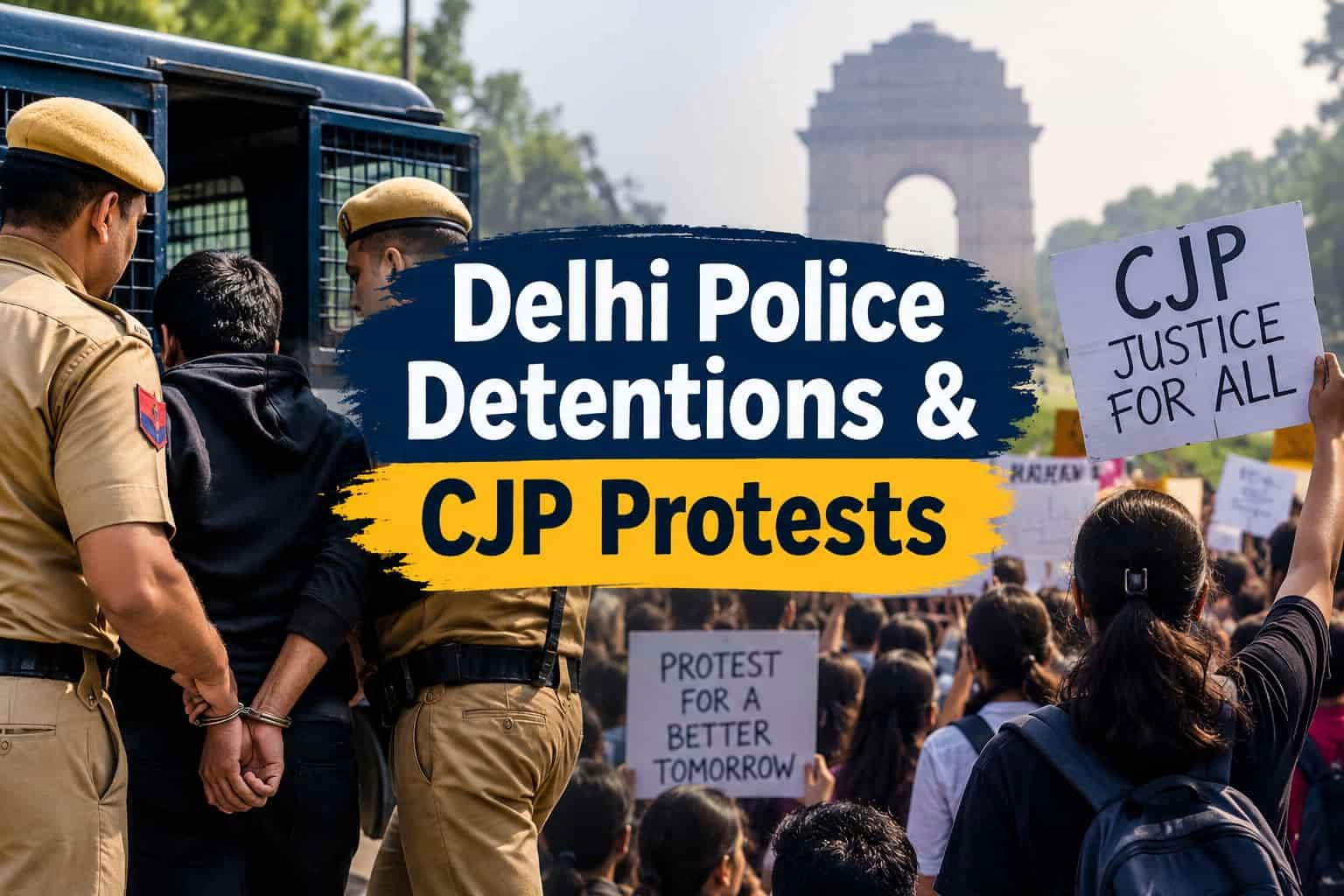
Delhi Police Detentions & CJP Protests have sparked debate over voter lists & protest rights. Read the latest updates, key demands, and police action.
What are Delhi Police Detentions & CJP Protests about? The reason for these detentions and what the protesters want is lost on many readers. The controversy is related to revision of voters’ lists and the demand for the resignation of Chief Election Commissioner and peaceful assembly. It may be hard to piece together the events if the reports contain conflicting information and details. The main points, the protests’ motivations and the police reaction are discussed in this article. It also filters out facts from allegations to make Delhi Police Detentions & CJP Protests clear to its readers.
Cockroach Janta Party (CJP) is a political party started by Abhijeet Dipke in May 2026, which is led by youth. It began as a spoof reaction to comments about young people that were controversial. It was a forum for students and citizens to voice their dissatisfaction with education, unemployment, and government accountability over the years.
Delhi Police Detentions & CJP protests have gained national limelight recently. The movement is questioning the voter-list revision. Chief Election Commissioner Gyanesh Kumar is sought to be ousted by the protesters. They assert that the modifications have the potential of taking away citizens that are eligible to vote. The Election Commission has dismissed the charges of political bias. There have also been concerns raised about police restrictions and the right to peaceful assembly in the protests.
What is the issue that protesters are protesting about?
The prime allegation in Delhi Police Detentions & CJP Protests is that of the Voter-list revision controversy in India. It is alleged by the Cockroach Janta Party (CJP) and other groups that the Special Intensive Revision (SIR) has eliminated the names of millions of people who could be eligible to vote. They are calling for a fresh look at the changes and resignation of Chief Election Commissioner Gyanesh Kumar. It is reported that over 130 million names were taken off electoral registers. The reason behind the exercise, according to the Election Commission, is to remove duplicate, deceased and ineligible entries.
It has denied allegations of political bias. The BJP has also denied any allegations that the revision had been done in favour of the ruling party. Protesters are concerned with the right to vote and citizens’ distrust of elections. Their demonstrations ask questions concerning the deletions and enhanced security for voters who are eligible.
Why Did Delhi Police Detain Protesters?
Delhi Police Detentions & CJP Protests have brought questions to the public order and right to peaceful assembly. It was reported that the Connaught Place demonstration was connected with police action.
Preventive action: Police took some protesters into custody before or during the march that was expected to cause law-and-order problems.
Police cracked down on the protest: Police placed restrictions on the protest. These actions included the planned demonstration and the movement of the demonstrators.
Public safety concerns: There was a public safety concern regarding crowd control and maintaining order in a heavily trafficked public space.
Activists detained: CJP’s founder Abhijeet Dipke and others were among the activists reportedly detained. Legal status should be determined for each individual by reference to latest reports.
Unapproved march: The march was not approved by officials, police said. They had already sent him a notice on the danger of proceeding with the gathering from the founder of CJP, Abhijeet Dipke.
Prohibitory orders: were in place in Connaught Place under Section 163 of the Bharatiya Nagarik Suraksha Sanhita (BNSS). Police said they would take legal action against those who violate these orders.
Crowd management: The authorities pointed out that the heavy traffic, limited entry and exit points and nearby Rajiv Chowk Metro station were safety concerns. A big crowd may block traffic and emergency access, they said.
FIRs and legal action: On Oct 17, it was reported that police had registered several FIRs alleging violation of prohibitory orders and obstruction of public servants. Over 100 demonstrators were reportedly arrested.
Other detained leaders, such as Abhijeet Dipke.
Founder, CJP Abhijeet Dipke
Established Cockroach Janta Party (CJP).
On October 16, 2026 detained prior to the slated “Lehra Do Tiranga” march.
Faced preventive action because of fear of possible breach of peace by police.
Neha Bora is a student activist.
All India Students’ Association (AISA) President.
Arrested as they headed to the protest.
The necessary formalities have been completed and it went to print on October 17.
SAURAV DAS and Ashutosh RANKA, CJP Leaders.
Both were said to have been beaten into submission and locked up for five days.
They had previously staged a protest at Jantar Mantar, and were subsequently detained.
Their cases have been a part of the attention that Delhi Police Detentions & CJP Protests garnered.
What Went On at the Tiranga March?
On October 16, 2026, the march ‘Lehra Do Tiranga’ was organised in Delhi without any police interference. The demonstration in Connaught Place was initiated by CJP founder Abhijeet Dipke to protest against the revision of voter-list and demand the resignation of Chief Election Commissioner Gyanesh Kumar. But police arrested Dipke before he could make it to the protest.
The protest went on, and the people and the student activists converged at Central Park and Palika Bazaar. They hoisted the Indian flag and shouted slogans. Other demonstrations occurred outside Mandi House. The police used a lot of security and arrested about 150 people during the protests. The incidents had Delhi Police Detentions & CJP Protests in the limelight.
The Voter-List Controversy Explained
The name on a voter’s roll dictates whether or not they are able to vote. This is one of the reasons why the Special Intensive Revision (SIR) has been a hot topic in India.
What is at stake?
Large-scale deletions: Millions of voter records have been reported as either having been deleted or marked for deletion in the revision.
Election Commission’s mantra: It’s a test of “old” records, such as those of deceased citizens and duplicate registrations and voters who moved.
Any worries in opposition: Critics believe that even if it is not complete or errors are not corrected, the real voters might also lose their registration.
Public accountability: Information about deleted names should be transparent, and there should be an easy way to fix errors.
The conflict has turned into one of the important incidents of Delhi Police Detentions & CJP Protests. CJP backers have resorted to demonstrations to demand accountability from the elections commissioners and resignation of Chief Election Commissioner Gyanesh Kumar. The big issue is the right to vote of all eligible citizens.
Human rights of public reaction and protest.
Public Reaction
Opposition, student organisations and civil-rights groups are responding to the Delhi Police Detentions & CJP Protests. A number of opposition members condemned the detentions and demanded the immediate release of activists.
Human Rights Watch also expressed concern about arbitrary detentions and called on the authorities “to respect peaceful demonstrations. These reactions have helped to draw more attention to the controversy surrounding voter-list revision. The issues raised by the protesters, along with the police actions and transparency in elections, are now in the spotlight.
Rights to protest and police restrictions.
The right to peaceful assembly and freedom of expression are guaranteed by Article 19 of the Indian Constitution with reasonable laws in place. The Delhi Police Detentions & CJP Protests have brought into question the balance which the authorities strike between these rights and the safety of the public.
The following are important factors to consider:
Freedom of assembly: The citizens have the right to peacefully assemble and may do so in accordance with the law.
Police authority: Police have the right to control demonstrations to ensure public order and to protect public areas.
Legal procedures: Detentions should occur in accordance with the legal procedures and applicable laws.
Freedom of expression: There are opportunities for protest, and the free criticism of public authorities within the law.
Public safety and citizens’ constitutional freedoms must be balanced: Authorities have to take into account both the safety of the public and citizens’ constitutional freedoms.
Latest updates are on 17th October 2026
On 17th October, it was Delhi Police Detentions & CJP Protests again that created a stir with new developments:
Abhijeet Dipke: CJP founder was put under preventive arrest by the police. He was supposed to stand trial in front of a Special Executive Magistrate.
Neha Bora: The AISA president, Neha Bora, was let go from detention after almost 12 hours.
Protest attendance: It was reported that despite police restrictions 2000 plus protesters were able to mass on Oct 16 in Connaught Place.
The activists continued to be preoccupied with the legal status of the activists, police action and calls for electoral accountability in the latest reports.
Frequently Asked Questions About Delhi Police Detentions & CJP Protests
Q1. What does CJP stand for?
CJP (Cockroach Janta Party) is a youth driven political organization, established by Abhijeet Dipke.
Q2. Which was the “Lehra Do Tiranga” March?
This protest was in Delhi on October 16, 2026, against the revision of the voter lists and to call for the resignation of the Chief Election Commissioner.
Q3. What does preventive detention mean?
Preventive detention is detention given to prevent a predicted threat, in compliance with the law.
Q4. Do those who have been detained have the right to contest their detention?
Yes. They may obtain legal representation and appeal against their detention by means of proper legal process.
Q5. What are the methods available for voters to verify they have their names on electoral rolls?
The voter can visit the official Election Commission of India website or visit the electoral registration office of their area.
Q6. What is the reason behind Delhi Police Detentions & CJP Protests being news?
The issues include voter-list issues, activist arrests and ballots and police power issues.






1 thought on “Delhi Police Detentions & CJP Protests: Key Updates 2026”